Coxons in England
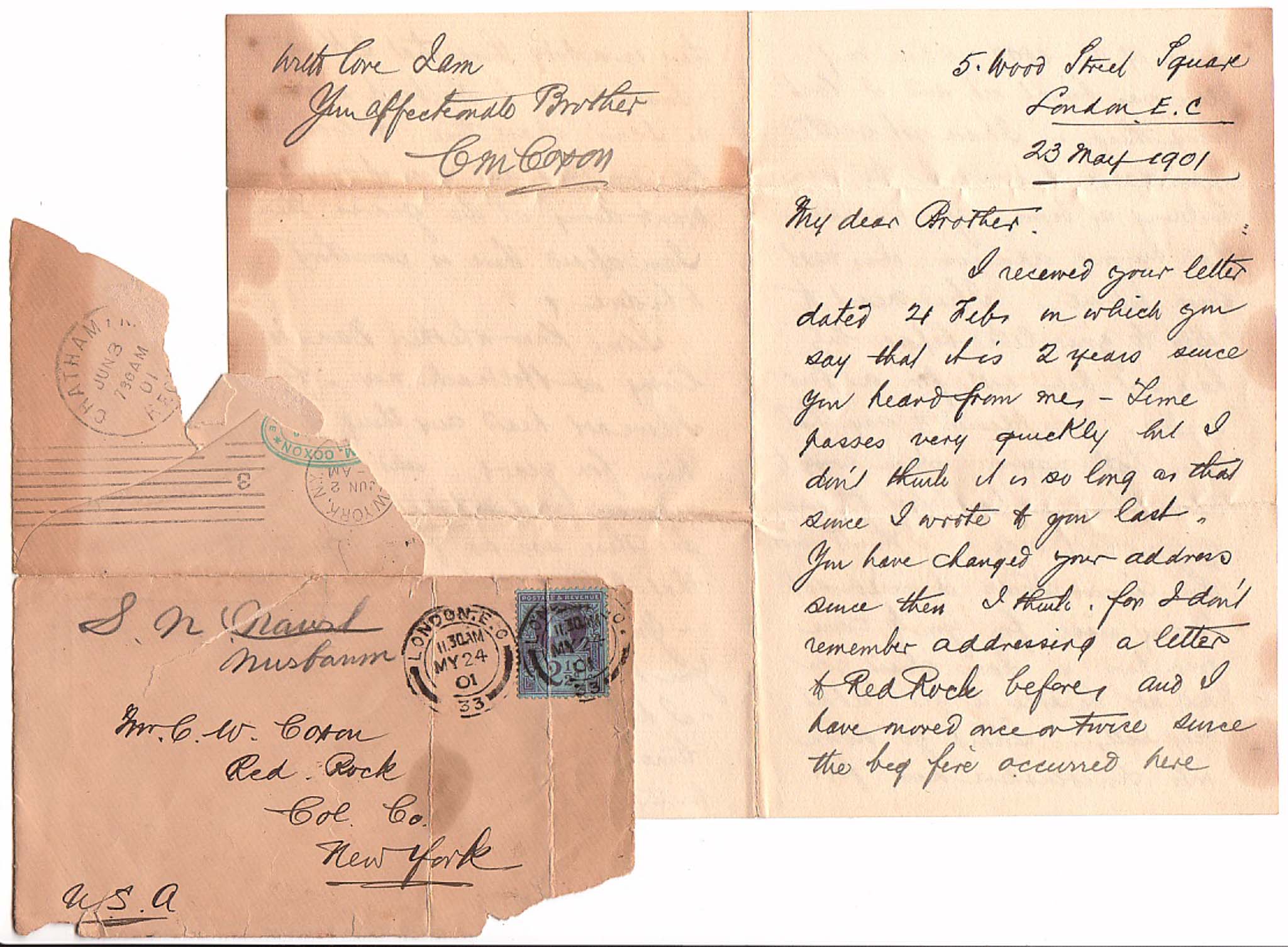
It all started with this brief letter sending me down a rabbit-hole pursuing my ancestral Coxons in England.
The Letter
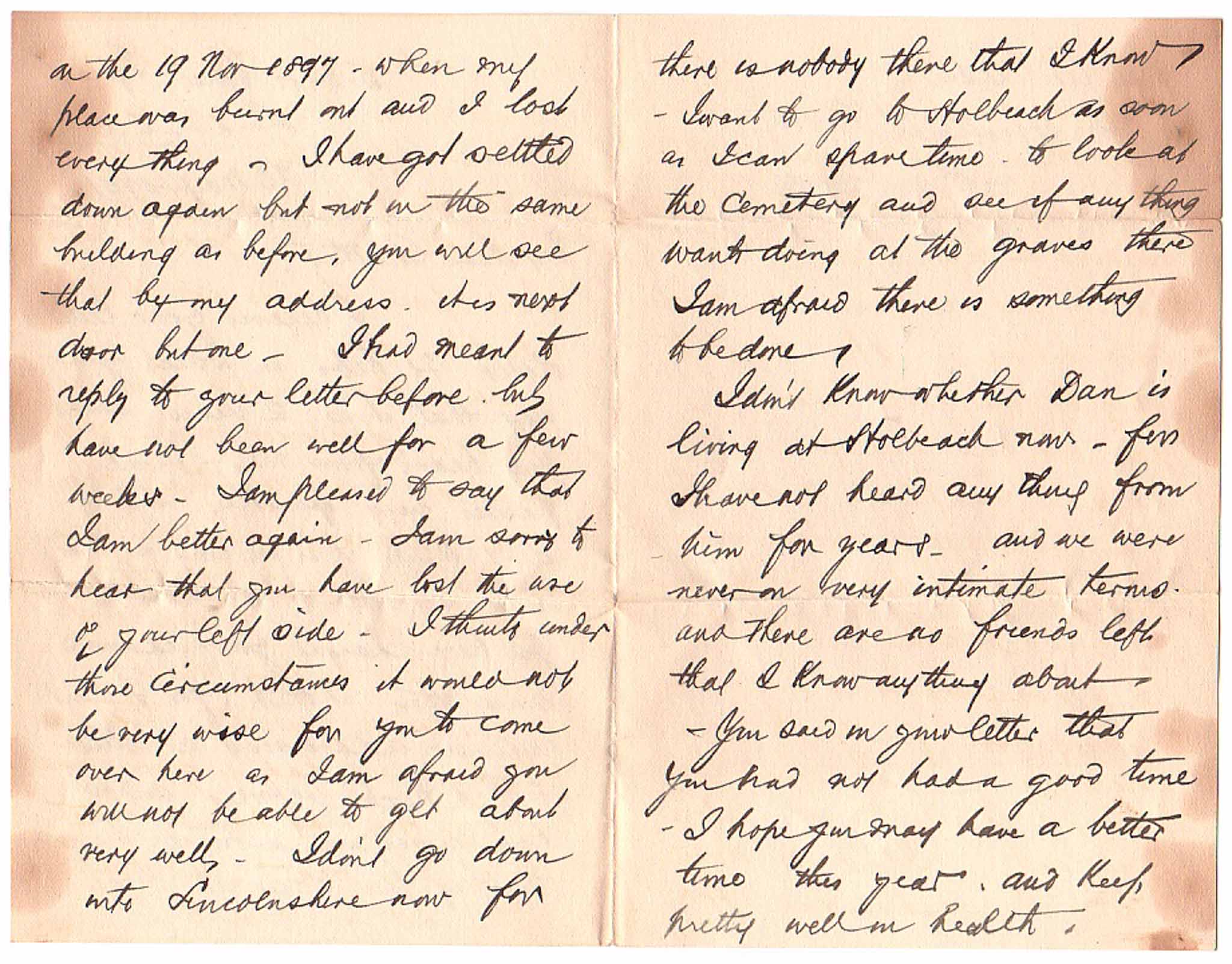
When I started looking into my Coxon family history I took note of this single surviving letter to my great grandfather, Christopher William Coxon (C. W. Coxon), from his brother in England, Charles Merriman Coxon (C. M. Coxon), that I found amongst Dad’s effects after he died. This short letter turned out to be a goldmine.
The Letter, Transcribed
5 . Wood Street Square
London E. C.
23 May 1901
My dear Brother.
I received your letter dated 21 Feb in which you say that it is 2 years since you heard from me. Time passes very quickly but I don't think it is so long as that since I wrote to you last. You have changed your address since then I think, for I don't remember addressing a letter to Red Rock before, and I have moved once or twice since the big fire occurred here
on the 19 Nov 1897 - when my place was burnt out and I lost everything - I have got settled down again but not in the same building as before. You will see that by my address - it is next door but one. I had meant to reply to your letter before but have not been well for a few weeks. I am pleased to say that I am better again. I am sorry to hear that you have lost the use of your left side. I think under those circumstances it would not be very wise for you to come over here as I am afraid you would not be able to get about very well. I don't go down into Lincolnshire now for there is nobody there that I know. I want to go to Holbeach to look at the Cemetery and see if any thing wants doing at the graves there. I am afraid there is something to be done.
I don't know whether Dan is living at Holbeach now - for I have not heard any thing from him for years, and we were never on very intimate terms. And there are no friends left that I know any thing about. You said in your letter that you had not had a good time. I hope you may have a better time this year. and keep pretty well in health.
With love I am
Your affectionate Brother
C M Coxon
Dad Rarely Mentioned his Grandfather Coxon
Dad mentioned his grandfather (at least I think it was his grandfather) coming over from England with his brother, who went back, never to be heard from again.
Great grandfather Christopher died 3 December 1906, two years before dad was born on 1 Aug 1908 so he never knew him. Christopher's wife Margaret died 1 May 1910 in Chatham.
I assume they were living at the time at what David Cooper refers to as the Coxon place, the first older house southeast of the intersection of County Routes 5 & 24 up toward Fog Hill. Or was that Dad’s parents, James and Iva Coxon who lived there?
I had never heard of the Coxon place until David mentioned it one day. Dad never talked about this stuff and somehow I wasn’t curious enough to ask about it. Grandma Iva died before I was born (31 Jan 1940) and Grandpa James lived with us for a while until he died 26 Nov 1950. I guess knowing that little bit satisfied my curiosity at the time.
There’s a Lot to Unpack Here
- This letter makes the story I heard about the brothers losing contact is not entirely true; the brothers were at least occasionally in contact by mail. And the brothers were of my Great Grandparents generation, not my Grandparents. Why did this letter survive and others did not?
- C. W. Coxon moved to Red Rock between 1899+/- and 21 Feb 1901. To the Coxon place? Moving in with his son, James's family?
- C. M. Coxon writes 23 May 1901 from 5 Wood Street Square, London E. C.
- C. M. Coxon moved once or twice since the big fire on 19 Nov 1897 when he was burnt out of his place next door to 5 Wood Street Square and lost everything.
- C. W. Coxon wrote in his 21 Feb 1901 letter that he had lost the use of his left side. In this letter his brother discourages him from coming to London. This seems to indicate there was some mention in an earlier letter of C. W. visiting London.
- C. M. doesn’t go down to Lincolnshire anymore as there is nobody there he knows. This seems to indicate they were from Lincolnshire.
- C. M. wants to go to Holbrook to look at the cemetery to see if anything wants doing. He fears there is. Is Holbrook in Lincolnshire?
- C. M. doesn’t know if Dan is living at Holbrook now; says he hasn’t heard from him for years and that they were never on intimate terms. Who is Dan? Is Dan a brother to C. M. and C. W.? In searching the web, I have not been able to find any indication Dan might be a brother.
- C. W. said in a previous letter he had not had a good time. C. M. wishes him well. I assume this refers to his loss of use of his left side but there may have been more.
Tracing Charles Merriman Coxon in London & Holbeach
Among other things, I've found voting records indicating Charles lived in a 1 room unfurnished flat at 14 Charterhouse Square & had qualified property at 7 and later 5 Wood Street Square.
1830-09-12 Christopher William Coxon Christening - HOLBEACH, LINCOLN, ENGLAND
1841 Christiana Merriman, Wakefield, Yorkshire - England and Wales Census, 1841
1851 Charles M Coxton, Fleet, Lincolnshire - England and Wales Census, 1851
1851 Christiana Coxton, Fleet, Lincolnshire - England and Wales Census, 1851
1851 William Coxton, Fleet, Lincolnshire - England and Wales Census, 1851
1861 Christiana Coxon, Fleet, Lincolnshire - England and Wales Census, 1861
1861 William Coxon, Fleet, Lincolnshire - England and Wales Census, 1861
1869 Charles Merriman Coxon Marriage - England and Wales Marriage Registration Index, 1837-2005
1872 William Coxon - Holbeach Directory pg 744-750 - Transcribed
1880 Christopher W Coxon Stuyvesant, Columbia County - Census
1890 Charles Merriman Coxon, Lodger - 14 Charterhouse Square
1896 Charles Merriman Coxon, Lodger - 14 Charterhouse Square
1897-11-19 The Great Fire in Cripplegate - City Press Supplement
1899 Charles Merriman Coxon, Lodger - 14 Charterhouse Square
1908 Charles Merriman Coxon, Lodger - 14 Charterhouse Square
1909 Charles Merriman Coxon, Lodger - 14 Charterhouse Square E.C.
1910 Charles Merriman Coxon, 3 Wood Street Square Qualifying Property, Holloway Road Abode
1910? Charles Merriman Coxon, Lodger - 4D Morgan mansions, Holloway Road
1911 Charles Merriman Coxon, Islington, N, London, England - England and Wales Census, 1911
Articles About Places Mentioned Above
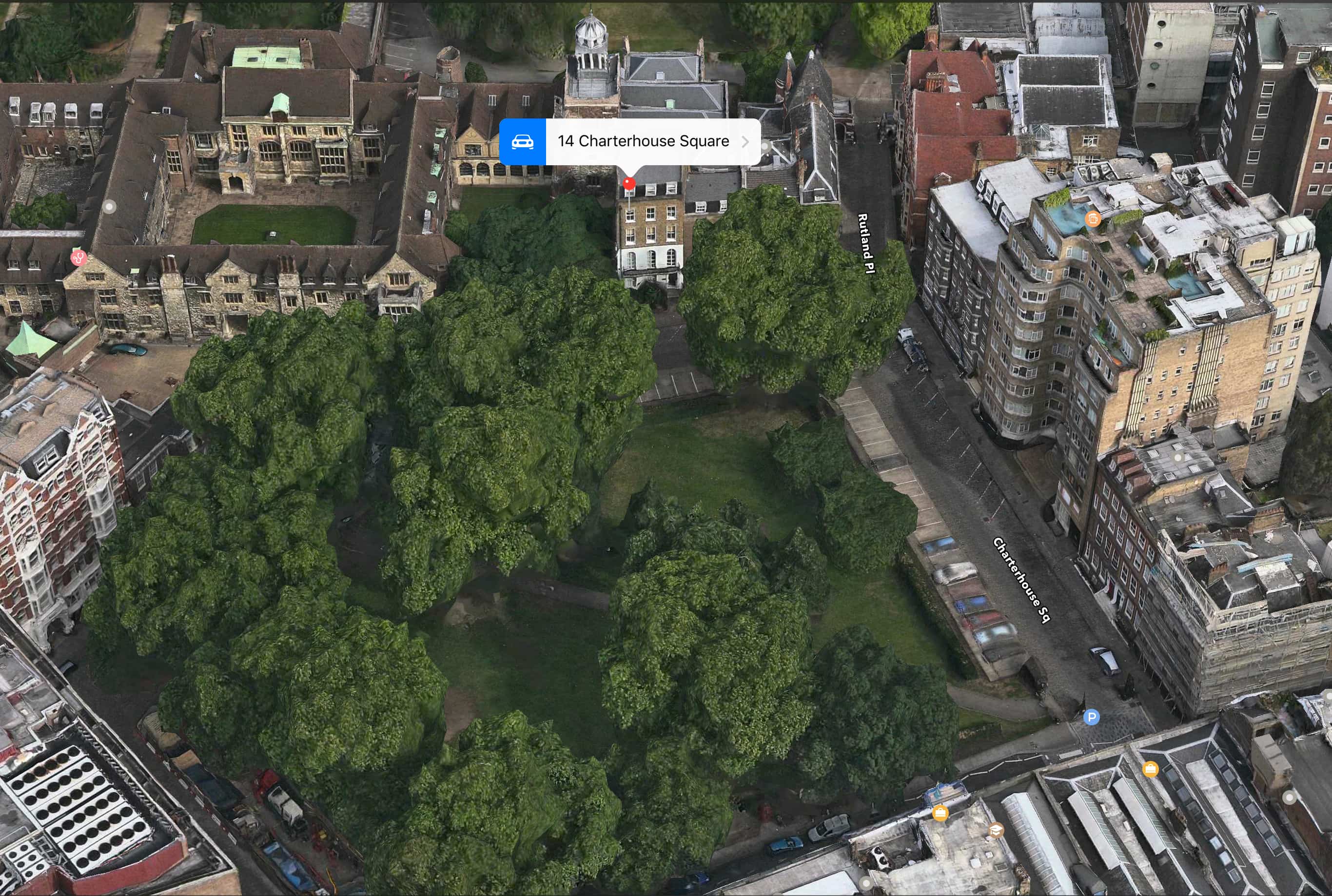
14 Charterhouse Square ( Google Maps / Apple Maps )
British History Online: CHAPTER IX. Charterhouse Square Area
North side
Occupying the north side of the square between the Charterhouse and Rutland Place is a small group of houses, Nos 12, 12a and 13-14. Though they all look like early nineteenth-century buildings (Ill. 355), Nos 13-14, formerly two houses but now thrown together, belong in part to the late seventeenth century. They once ranged continuous to the west with a wing of the Charterhouse, and to the east with a short run of houses which touched the corner of No. 11 on the east side. The roadway of Rutland Place to their east is a creation of the 1820s.
The origin of this group is bound up with the history of Rutland House, to be covered in the monograph on the Charterhouse. The south-western corner of that mansion, including a narrow entrance into its main courtyard, occupied the sites of Nos 12 and 12a (Ills 333, 336, 337). The break-up of the Rutland House property followed upon its return to the ownership of the 2nd Duke of Buckingham in 1660 after the Restoration. In 1662 Buckingham granted the main house to John Eaton, mercer, who invited James Nelthorpe, a resident of Charterhouse Yard, to purchase a half share. (fn. 88) In 1688 the latter's brother, Sir Goddard Nelthorpe, leased the portion west of the entrance and courtyard to Francis Stacey, citizen and clothworker, for 52 years. Stacey was required to pull down the existing buildings and build two new 'good and substantial' brick houses of the second rate, to be completed by that Christmas. (fn. 89) A former gallery behind was to be rebuilt and incorporated into the eastern house. The outcome was an unequal pair of houses, No. 14 threeand-a-half windows wide, No. 13 six-and-a-half windows wide; the eastern half of No. 13 covered the site of the present No. 12.
By the 1780s No. 13 was a boarding-house for Charterhouse schoolboys, but No. 14 remained a private residence. (fn. 90) Here Samuel Sharwood, a leather cutter, acquired the freehold and seems to have made substantial alterations about 1810-11. (fn. 91) These entailed adding a storey, refacing the building with yellow stock bricks and remodelling the first floor with French windows and a balcony with cast-iron railings, formerly supplemented by a trellis and awning. Much of the rendering on this storey, however, is due to alterations by the Charterhouse's architects Seely & Paget in the mid-1960s. (fn. 92)
1. Nos 12-14 Charterhouse Square (right to left) in 1997
Between 1810 and 1825 the headmaster of Charterhouse School, the Rev. John Russell, acquired all the sites in this corner of the square and gave it the present configuration. He bought No. 14 from Sharwood for £2,500 in 1818, turning it into another boarding-house like No. 13. (fn. 93) Next he bought the adjacent properties to the east, acquiring a lease from the Charterhouse of an old gabled house that had been the entrance to Rutland House, and part of the freehold estate of Sir Robert Harry Inglis beyond. This enabled him to abolish Rutland Court, the open space north of the Rutland House entrance, and lay out the line of Rutland Place further east. (fn. 94) On the east side of this new cul-de-sac he built two three-storey houses in 1826-7, Nos 1 and 2 Rutland Place (on the site now occupied by the former headmaster's house of Merchant Taylors' School). (fn. 95) On the south-west corner in 1832 Russell erected a third house, No. 3 Rutland Place, now No. 12A Charterhouse Square. (fn. 96) Originally the front elevation had no bow window, but a pair of flush windows to the ground and first floors. (fn. 97)
Following Russell's resignation as schoolmaster, his properties were bought in September 1833 by John Cross, a watch manufacturer at No. 41 Charterhouse Square, who undertook alterations. These involved dividing No. 13 into two, and rebuilding the fronts to the square so as to create the present No. 12. The unbalanced frontages of Nos 12 and 13 echo the original six-and-a-half bay façade. (fn. 98)
2. No. 13 Charterhouse Square, plan and panelling of first-floor front room
For some years the four houses reverted to private residences. Nos 13 and 14 were occupied in the 1850s and 60s by surgeons of distinction connected with St Bartholomew's Hospital—respectively, William Scovell Savory (later baronet), President of the Royal College of Surgeons and surgeon-extraordinary to Queen Victoria, and his colleague Frederic Carpenter Skey. But from around 1870 Nos 12, 13 and 14 all became boarding-houses, soon euphemistically called hotels. [Noted] One was Kershaw's Hotel, initially at No. 14, extended in 1884 to No. 12 to add to two further houses James Kershaw had in the square. This commercial hotel, successfully continued by his daughter Alice Gurner[1], was the only one in the square deemed worthy of mention in the 1879 edition of Baedeker's London guide. (fn. 99) By 1905 under new management renamed the Brunswick Hotel, it covered Nos 12, 13 and 14. (fn. 100) The last name for a hotel at these addresses was the Fife Hotel (c. 1912-38). Since then these houses have largely been used as offices.
Between 1887 and 1903 No. 12a acted as a boardinghouse for Merchant Taylors' School, which took over the Charterhouse school site in 1872. (fn. 101) It was then occupied by the developer Mark Bromet, one-time rag and general merchant at the Charterhouse Works, Northburgh Street, who added the present three-tier bow window at the front in 1904-5. (fn. 102) The house served as the rectory of St Bartholomew-the-Great from about 1907 to 1913.
The interiors of the four houses reflect their chequered history. At No. 14 there are remains of the seventeenth-century stair-rail. Otherwise the dog-leg staircase has typical early nineteenth-century balusters. The staircases at Nos 12a, 12 and 13 are also of early nineteenth-century type, but No. 12a also has a short extra stair-rail on the first-floor landing, with four twisted balusters of c. 1700, perhaps from another house. Remarkably, the front firstfloor room at No. 13 retains its late seventeenth-century form, complete with bolection-moulded panelling and a blocked doorway formerly connecting with the eastern half of the house (Ill. 356).
[1] In the Voting Register Alice Gurner is listed as the proprietor letting an unfinished room to Charles Merriman Coxon.
clipped 2016-08-15: http://www.british-history.ac.uk/survey-london/vol46/pp242-265
Wood Street Square
Wood Street Square seems to have been west of Wood Street between Munkwell Street and London Wall at the site of the Church of Saint James in the Wall also known as Lambe's Chapel.
Plaque: All Hallows tower and Lambe's Chapel
The Clothworkers' Company
The Tower of All Hallows Staining, dated c1320, is believed to be part of the second church on this site. The second church survived the Great Fire of 1666, although the adjacent Clothworkers' Hall was razed to the ground. In 1671 the church collapsed owing, it is thought, to weakening of the foundations caused by the large number of burials in the adjoining churchyard. Rebuilt in 1674, it was finally pulled down in 1870 on the amalgamation of the Parish of All Hallows with the Parish of St Olave, Hart Street. Between 1948 and 1954 the Tower formed the chancel of a pre-fabricated church, known as St Olave, Mark Lane, substituting for St Olave, Hart Street, which had been gutted during the Second World War.
The William Lambe Crypt
In 1543, after the dissolution of the monasteries, the Chapel of St James in the Wall was granted to William Lambe, Master of the Clothworkers' Company 1569 - 1570. He is renowned for bringing water to that part of London later crossed by Lamb's Conduit Street, WC1.
The chapel was beside London Wall in Monkwell Street, near Monkwell Square. Later called Lambe's Chapel, it was demolished and rebuilt c1825. It was demolished again in 1872, when its crypt of c1200 was brought here by The Clothworkers' Company and placed beneath All Hallows Staining tower. One of the monumental brasses from Lambe's Chapel survives in St Olave's, Hart Street.
The Tower and Crypt are maintained by the Clothworkers' Company.
clipped 2016-08-15: all-hallows-tower-and-lambe-s-chapel
(St.) James' in the Wall Hermitage
(St.) James' in the Wall Hermitage
A chapel or hermitage adjoining the north-west corner of the Wall of London near Cripplegate in Farringdon Ward Within. (Site shown O.8. 1880.)
Known as "Cripplegate Hermitage" and "Saint James in the Wall."
First mention: Given by Richard I. to his chaplain Warin, mentioned in 39 H. III. 1255 (Cal. Pat. Rolls, H. III. 1247-58, p. 402).
But in an Inquisition, 8 Ed. III. 2nd Nos., No. 78, it is said to have been founded "per Johannem quondam RegemAnglie de assensu communitatis ciuitatis London."
In an Inquisition taken 27 Ed. I. (No. 127) the hermitage is said to have been built on ground upon which in time ofwar perambulation ought and is accustomed to be made, and that the chapel ought to be destroyed if the city werebeseiged on that side, as the city could be easily taken on that side.
In the 18 Ed. I. a lane was granted for the enlargement of the place (loci) of St. James Chapel by Crepilgate to thechaplains and hermits thereof (Cal. P.R. Ed. I. 1281-92, p. 401).
A cell to the Abbot of Garendon in 1289 (Cal. L. Bk. A. p. 118, note).
The tenement of the Hermit of Crepelgate is mentioned in a will of 1297-8 as in the parish of St. Nicholas Hakoun, and this was probably a tenement devised to him for maintenance.
Henry de Causton in his will made a bequest to the Abbot and hermits of the hermitage withim Crepelgate, 1350(Ct. H.W. I. 638).
Described as the parish of "St. James in the Wall," 1580 (London, I. p.m. III. 99-101).
From these entries it would appear that the chapel and its appurtenances were more considerable in importanceand extent than is generally implied by the use of the term "Hermitage," and it seems probable that the cell wasoriginally founded as an Hermitage and that other and perhaps more extensive buildings were added at a later date, possibly at the time of the enlargement of the "place" mentioned in the Inquisition, 8 Ed. I.
In the reign of Edward I. it was placed under the protection of the Mayor of London and afterwards of the Constableof the Tower (Gent. Mag. Lib. XV. 288-90).
It came into the King's hands in 1537 by reason of the suppression of the monastery of Garadon in Leicestershire, the chapel being a house or cell of the abbot (L. and P. H. VIII. XII. (1), p. 142).The chapel was granted in 1543 to William Lambe, together with the cemetery adjoining beside London Wall, described as within Creplegate in the parish of St. James within London, 34 H. VIII. 1543 (L. and P. H. VIII. XVIII (1), p. 201).
In 1632 it is described as in the parish of St. Olave (ib. Chas. I. V. p. 491).
See Lamb's Chapel.
With reference to the date of the foundation of this chapel and Hermitage, very interesting discoveries were madeon the occasion of the rebuilding of Lamb's Chapel, c. 1825. The demolition of the upper part of the edifice renderedaccessible a curious crypt below, the groined roof of which was supported by short columns of Norman work. The stonework was adorned with the zigzag ornament characteristic of that period, and the remains suggest an evenearlier origin for the Hermitage than the earliest record set out above.
At a few paces from the eastern end of the building is the base of a round tower which strengthened the north-western angle of the Wall of London (Gent. Mag. Lib. XV. 288-91, and See Trans. Lond. and Midd. Arch. Soc. I. 345).
Clipped 2016-08-15 from a site no longer available. jhc
Directory with directions to Wood Street and to Wood Street Square with earlier names
Wood Street
North out of Cheapside, at No.122, to London Wall (P.O. Directory). In Farringdon Ward Within and Cripplegate Ward Within.
First mention: "Wodestrata," 1156-7 (Cal. Doc. in France, p.156).
Other forms : "Wude-strate," Rich. I .(Anc. Deeds, A. 2124). " Wdestrate," 5 John (ib. A. 2502). "Wodestrete," 24 H. III. (Ch. I. p.m.).
Afterwards called Great Wood Street and Little Wood Street (S. 292), and down to The 19th century.
Great Wood Street was the southern portion from Cheapside to Addle Street, and Little Wood Street the northern portion to London Wall.
Stow makes the following suggestion as to the origin of the name: first that the houses in this street had always been built of timber and not of stone. (This hardly seems a sufficient explanation when so many other houses must have been built of timber.) Secondly, that it was named after Thos. Wood Sheriff, 1491. But as shown above, the street received its name long before this date.
Kingsford suggests (ed. Stow II.338) that wood was sold here, and this is quite a possible explanation, other streets in the locality such as Milk Street, Honey Lane, being named after the commodities sold in them, or in the great market of Cheap to which they were adjacent.
Pavements of tesseræ were found here in 1843 and 1848, and fragments of Gaulish pottery beneath the foundations of the Old Crosskeys Inn in 1865. Roman bricks said to have been found in St. Alban's Church in 1632.
Wood Street Square
West out of Hart Street at No.3 at its junction with Monkwell Street, in Farringdon Ward Within (P.O. Directory).
First mention: 1871.
Former names: "Chapel Court" (Horwood, 1799-Elmes, 1831). "Lambs Chapel Court" (Strype, ed. 1720-Lond. Guide, 1758). "Lamb's Court" (O. and M. 1677)."
Clipped 2016-08-15: dictionary-of-london
— page revised 2026-09-29 - jhc